I’ve lived through a unique technological schism: the tactile, analogue 80s and the explosive, digital 90s. This wasn’t just a change in gadgets; it was a total shift in how we interact with the world. My journey into this space wasn’t driven by a career path, but by a childhood fascination with a certain Vulcan and a series of expensive mistakes.
The Spock Logic and the Betamax Sacrifice
While other kids were drawn to the phasers and photon torpedoes of Star Trek, I was captivated by Spock. His reliance on cold logic and his rejection of messy emotion appealed to me. I wanted to live in that clean, high-tech future where everything had a purpose.
I took it apart, driven by curiosity, only to learn my first hard lesson in engineering: disassembly is easy; reassembly is where the logic lives.
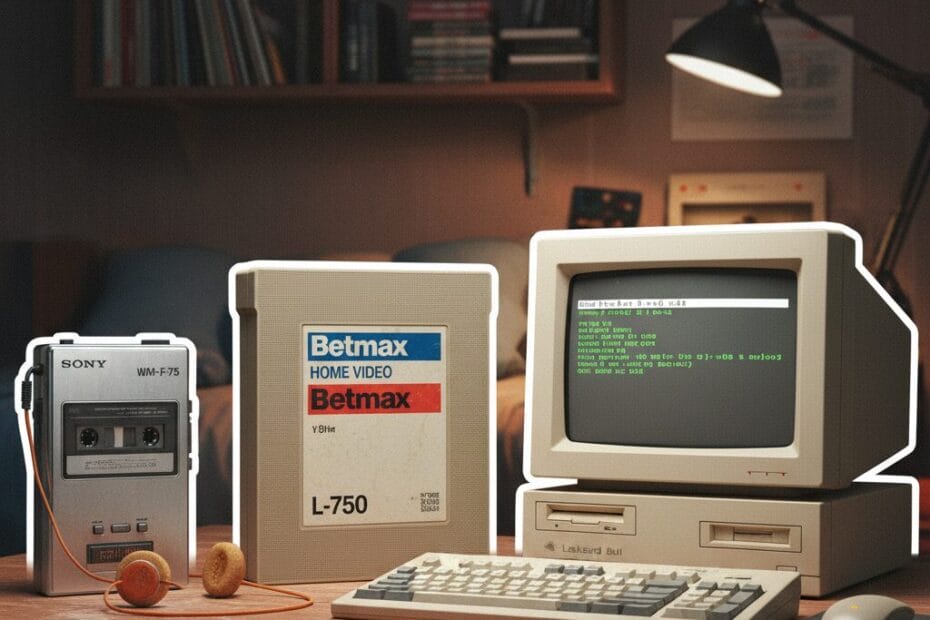
My first “lab” was my bedroom, anchored by a dying breed of technology: a Betamax player. As the world surrendered to VHS, this heavy, unwanted beast was gifted to me. While my sister couldn’t have cared less about having a TV in her room, for me, it was a private sanctuary for Thomas the Tank Engine. But the Spock in me needed to know how the tape moved. I took it apart, driven by curiosity, only to learn my first hard lesson in engineering: disassembly is easy; reassembly is where the logic lives. I never got it working again, but the spark was lit.
The Art of the Sunday Mixtape

The late 80s were defined by the Hi-Fi stack—the altar of the living room. I’d spend hours playing my mum’s Beatles and Queen records, but my real work happened on Sundays. Using the hi-fi, I’d record my own mixtapes—carefully timing the songs to avoid the DJ’s voice on the radio or recording directly from vinyl.
My Walkman, an unbranded non-Sony model, was my constant companion from the late 80s through the late 90s. It survived the shift in my musical tastes, from radio pop to Oasis on repeat. Those mixtapes weren’t for anyone else—they were the soundtrack to my own private world.
1996: The Packard Bell Powerhouse
The real turning point was 1996. My mum made a massive investment—over £2,000 in today’s money—on a Packard Bell P75. It was a “beast” by the standards of the day: 75MHz, 8MB of RAM, and an 800MB hard drive. Moving from the clunky Windows 3.1 machines at school to Windows 95 at home felt like stepping into the future.
Naturally, I broke it.
Without the internet or AI to guide me, I had to learn through pure trial and error. I remember the nightmare of IRQ conflicts—a concept modern PC builders will thankfully never know. I couldn’t get the sound card and the printer to play nice on the same interrupt. My “bodge” was a Spock-like logical workaround: two separate boot profiles. One for gaming with sound, one for printing homework. It was inefficient, but it worked.
The “Computer Monitor” and the OS/2 Warp Mystery
At school, I was one of several “computer monitors.” This meant I spent a lot of time in the computer room during lunch breaks and after school (when I wasn’t in detention). I was the go-to person for students struggling with the tech, especially the handheld scanner—a device so temperamental that the slightest tremor or deviation in speed would ruin the entire scan. It required the steady hand of a surgeon.
But the real mystery lay in the “server room.” I used to watch over the shoulder of the IT teacher as he worked on a massive OS/2 Warp server. I never got to touch it, but I was fascinated by it. It felt like the “grown-up” version of the tech I had at home—a glimpse into the infrastructure that kept everything running.
Everyone else tended to raise their eyebrows or drift away when we started geeking out.
The Pool Centre and the Birth of “The Unknown Universe”
My technical education accelerated in my late teens at the local pool centre. It was a massive part of my life, and I met one other person there who shared my passion for tech and sci-fi. Everyone else tended to raise their eyebrows or drift away when we started geeking out.
That friend became my primary source for “old tat”—spare parts that I used to bodge together a Windows 98 machine. My mum couldn’t understand why I was replacing her expensive PC with a Frankenstein’s monster of beige plastic, but once she used it, she knew I was right. The pool centre was a hub of community until the council tore it down in 2008—a huge loss for many friendships and shared passions.
Then came the internet. For years, my mum claimed we couldn’t get it because the “railway bridges” blocked the signal—a bit of village lore she truly believed. Eventually, Telewest arrived, and the world opened up. By the early 2000s, I got my first laptop. The ISP provided a basic modem, but I wanted more. I went out and bought a wireless router. It was insecure and basic, but when I had to give the SSID a name, I chose “The Unknown Universe.” It has been the name of every network I’ve built since.
Full Circle: Supporting Mum and Returning to PC
I spent years in the console trenches—NES, N64, GameCube, and a long stint in the Xbox ecosystem. But recently, I’ve felt the pull back to my roots. The closed-off nature of modern consoles started to grate against my love for FOSS and privacy.
Today, I’m the one providing tech support for my mum, but I do it on my terms. Quick fixes happen remotely using my own RustDesk service, but for true support, I visit in person. Although she’s in her 70s, she’s ahead of her peers in tech skills—definitely compared to my nan, who I used to spend hours helping with TV retuning after the digital switchover. I still remember those evenings watching snooker together once everything was fixed.
I miss the privacy of the analogue era—the lack of a digital footprint—but I wouldn’t trade the convenience of my home lab for anything. I’ve gone from breaking Betamax players to managing containers in Proxmox. The tech has changed, but the logic remains the same.