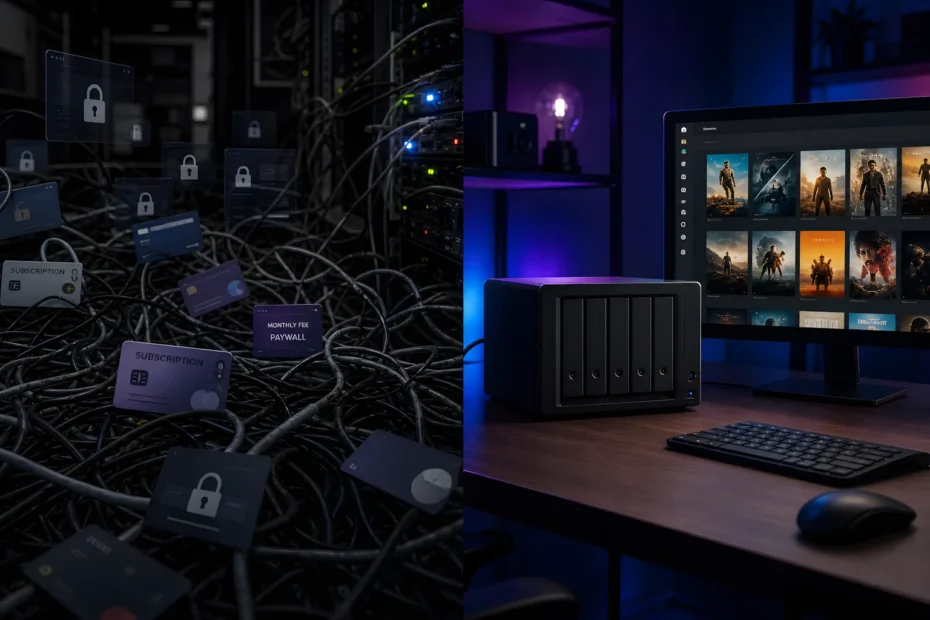
I’ve been a Plex user since 2012.
Back then, I paid around £50 for a lifetime Plex Pass. It felt like a bargain. Plex was a genuinely useful piece of software that solved a problem many of us in the home lab and self-hosting community had: how do you access your own media collection easily from anywhere?
For years, Plex was exactly that. I pointed it at my media library, it fetched artwork and metadata, and it let me watch my content on almost any device I owned. Job done.
Fast forward to 2026 and things feel very different.
Recently, I finally moved my video library to Jellyfin. Surprisingly, it wasn’t because of a technical issue. Plex still works. The problem is that Plex increasingly feels like a company focused on monetising its users rather than improving the experience that made people sign up in the first place.
In other words, Plex has started to look like a textbook example of enshittification.
What Is Enshittification?
The term was popularised by writer Cory Doctorow and describes a pattern that has become depressingly common in technology.
A service starts by being useful to attract users. Once it has enough users, it begins prioritising business interests over those users. Features get restricted, subscriptions become more expensive, and friction is introduced where none previously existed.
The service still works, but it feels like it’s constantly nudging you towards spending more money.
Sound familiar?
The Pricing That Made Me Raise an Eyebrow
As someone who bought a lifetime Plex Pass for around £50 over a decade ago, the current pricing is difficult to ignore.
At the time of writing:
- Plex Pass Lifetime costs $249.99 USD.
- Plex has announced this will increase to $749.99 USD from 1 July 2026.
- Plex Pass monthly and annual subscriptions remain available.
- Remote streaming of personal media now requires either a Plex Pass or a Remote Watch Pass.
That last point is what really stands out to me.
Remote access was once a core reason many people chose Plex. Being able to stream your own media from your own server while away from home felt like a fundamental feature of a personal media server.
Today, access to that functionality increasingly feels tied to additional monetisation.
Whether you think that’s reasonable or not, it represents a noticeable shift in direction.
Why I Moved to Jellyfin
I didn’t leave Plex in a dramatic rage. There was no angry social media post. No rage-delete of containers.
I simply reached a point where I realised I preferred the alternative.
Jellyfin is free and open source. There are no subscriptions. There are no premium tiers. There are no features being held back for a future pricing announcement.
Most importantly, Jellyfin’s goals seem aligned with my own.
I want software that helps me access my media collection. Jellyfin wants to help me access my media collection.
It’s refreshingly uncomplicated.
The Migration Was Almost Boring
One thing I lost during the move was my watch history.
Apparently that’s a major concern for some people. For me, it barely registered.
The reason I self-host media has never been to maintain a detailed record of everything I’ve watched. I self-host because I want reliable access to media I’ve purchased, without worrying about catalogue changes, licensing agreements, or whether a streaming service decides to remove something next month.
Take Star Trek as an example.
Over the years I’ve built a complete collection of every episode and movie and stored it on my NAS. If I suddenly decide I want to watch an episode of Deep Space Nine, I don’t need to check whether it’s available on a particular platform. I know exactly where it is.
That’s the value of self-hosting for me. Availability beats analytics every time.
The actual migration was almost embarrassingly easy. All my media already lived on my NAS. I deployed a Jellyfin container, pointed it at the same network shares Plex was already using, and waited for it to scan the library.
That was pretty much it.
No file migration. No copying terabytes of data around. No late-night troubleshooting session fuelled by coffee and poor decisions.
The watch history disappeared. The media didn’t. Between the two, only one mattered.
The One Thing Plex Still Does Better
Despite all of this, I haven’t completely abandoned Plex.
Plexamp remains one of the best self-hosted music applications I’ve ever used.
The interface is polished, music discovery features are excellent, works with Android Auto and the overall experience is genuinely enjoyable. I’ve tried alternatives and, so far, none have convinced me to switch.
So while my video library now lives in Jellyfin, my music collection still flows through Plexamp.
It feels slightly contradictory, but technology choices don’t have to be all or nothing.
Final Thoughts
Plex isn’t evil.
It still works. It still has a large user base. Plenty of people will continue using it and be perfectly happy.
The problem is that the company seems increasingly focused on becoming a media platform rather than a media server.
Many of us adopted Plex because it gave us control over our own collections. Over time, that focus appears to have shifted towards subscriptions, passes, and recurring revenue.
Jellyfin, by contrast, remains stubbornly focused on doing one thing well: serving media you already own.
Maybe that’s why the transition felt so natural.
I wasn’t looking for more features. I wasn’t looking for AI recommendations, social integrations, or another subscription.
I just wanted a media server.
And somewhere along the way, Jellyfin became exactly that. Plex forgot.