Watching a Prime Minister resign in a flurry of headlines is a classic British distraction. While the news cycle fixates on who’s moving into Number 10, the laws they actually passed aren’t going anywhere. The “Nude Ultimatum” and the Online Safety Act were bought and paid for long before the tears started on the Downing Street steps.
To understand why a new leader won’t just fix this, you have to look at the “Vicious Circle” that built it.
This isn’t just a bad law; it’s a rigged market. For years now, a handful of private tech firms have been consulting with the government. They provided the scary data that made the internet look like a nightmare and then whispered that their specific AI algorithms were the only real solution.
It’s textbook regulatory capture. The government wrote a law that requires highly accurate facial estimation and identity verification as the default. By a massive coincidence, those are the exact products sold by the people who helped write the law. They didn’t just win a contract, they lobbied a market into existence. Every time you have to prove your age to a private contractor just to access a site, you’re basically paying a digital tax to a state-mandated monopoly.
The proof that this is about profit, not safety, is in who they’re trying to kill off. Organisations like Mozilla and Proton have already said they won’t comply with any order to break encryption or turn their software into government spyware.
Proton, for example, is based in Switzerland and uses a zero knowledge model. They literally can’t scan your data because they don’t have the keys. For them to comply, they’d have to set fire to their entire business. The government knows this. They know the privacy-focused options can’t play ball, which gives them the perfect excuse to push people toward the “approved” contractors or block these tools at the ISP level because they don’t meet the “safety standards” written by their own competitors.
There’s some hope that a change in leadership, someone like Andy Burnham, perhaps might mean a pivot. I wouldn’t bet on it. Burnham has a track record of championing centralised, integrated digital systems. He’s a better communicator than the last lot, but that just makes the digital ID easier to sell. A bad idea wrapped in a common sense flag is usually more dangerous than one delivered by a failing politician.
The Vicious Circle only works if you stay inside the loop. As long as you’re dependent on centralised platforms that are forced to surrender to these contractors, your identity is just a commodity.
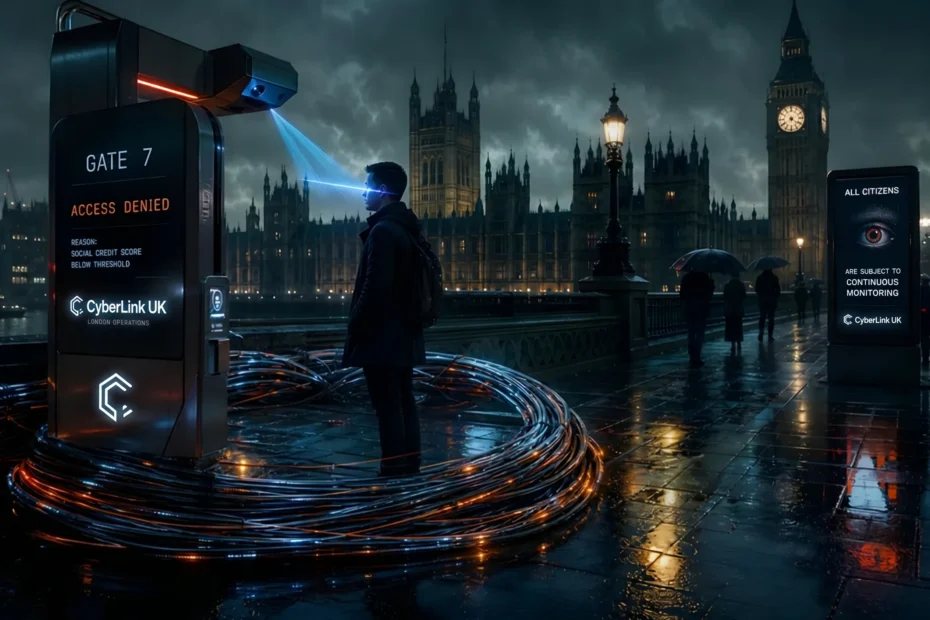
Looking at the featured image for this post, a digital gate standing in the middle of a rainy Westminster bridge. It’s easy to think of this as science fiction, but we’re already there. When you’re forced to hand over your bio-metric data to a private firm just to access a conversation, the line between online and real life has vanished. That gate isn’t just on your screen; it’s a checkpoint on your civil liberties.
This is why I’m doubling down on self-hosting and FOSS. In our house, we don’t need a facial-scanning AI to tell us how to manage a network, we use local blocks and parental education. Sovereignty isn’t about what browser you use, it’s about who owns the infrastructure of your life. Every service you self-host is one less cable coiling around your feet. It takes more effort to build your own way, but it’s the only way to opt out of a game that was rigged before it even started.