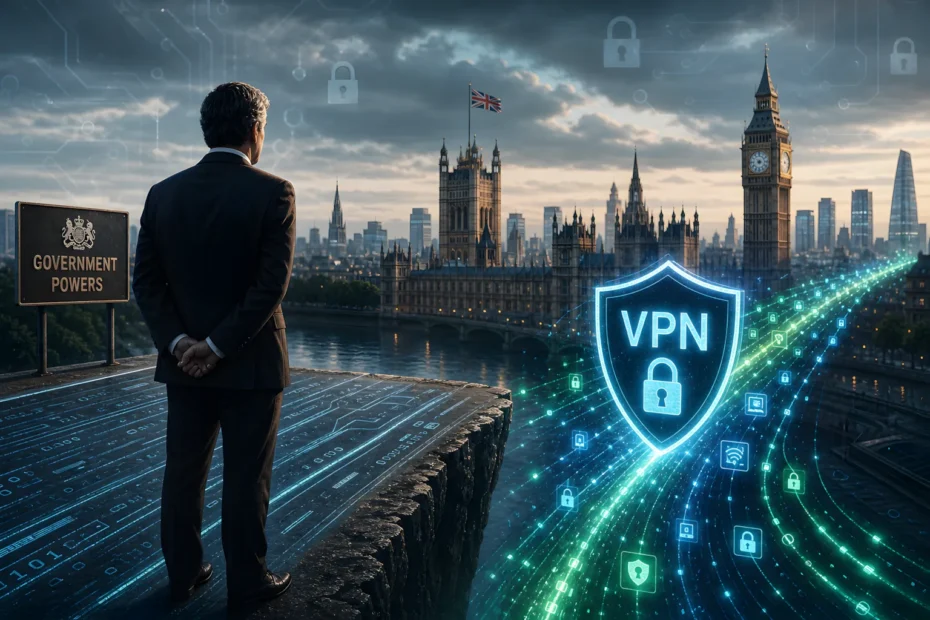
If you woke up on 15 July feeling a strange sense of relief, you aren’t alone. After months of posturing, rhetoric, and vaguely defined threats toward privacy tools, the UK government has officially confirmed, they will not be limiting access to Virtual Private Networks (VPNs).
The headlines are, predictably, framing this as a “major victory” and a “gracious decision” by ministers to listen to privacy concerns. Let’s be clear, this isn’t a victory of benevolence, it’s a victory of physics.
They Didn’t Pivot, They Ran Out of Runway
When Online Safety Minister Kanishka Narayan told BBC Breakfast that the government had decided not to restrict access to VPNs, most tech-savvy observers knew exactly what wasn’t being said. The official justification, fuelled by a new report from the Department for Science, Innovation and Technology (DSIT), claims that usage data shows teenagers use VPNs largely for, well, privacy. Apparently, only 7–10% of children were using these tools to circumvent age checks, while nearly half were simply entering a fake date of birth.
It is a convenient set of numbers. It gives the government a perfect “off-ramp” to save face. By focusing on the statistics, they can avoid the much more uncomfortable admission: they realised they couldn’t do it.
The Technical Reality Check
For the last six months, anyone with a passing understanding of networking has been trying to explain the reality of the situation to policymakers who seem more comfortable with rhetoric than with TCP/IP fundamentals.
Attempting to ban a VPN is not like banning a single app or a specific domain. You cannot regulate a protocol.
If the government had followed through on their more draconian suggestions, they would have had to:
- Target encryption: VPNs are essentially encrypted tunnels. To ban them, you would have to break the end-to-end encryption that secures banking, medical records, and enterprise infrastructure.
- Engage in Deep Packet Inspection (DPI): To identify a VPN, you have to inspect the data packets in real-time. This is resource-intensive, privacy-invasive, and technically easy to bypass. With protocols like WireGuard or OpenVPN running on port 443, the same port used by standard HTTPS, identifying non-compliant traffic becomes a game of cat-and-mouse that the regulator will always lose.
- Criminalise Home Labs: The moment they banned commercial VPN providers, millions of self-hosters would have simply spun up their own WireGuard or Tailscale instances on a VPS or a spare Raspberry Pi. How do you regulate an encrypted SSH tunnel to a personal server? You don’t.
The civil servants and technical advisors in the room likely sat the politicians down and explained that they were effectively trying to legislate the laws of math. Trying to block VPNs would require a level of deep surveillance that would turn the UK into a digital island, alienating the tech sector and breaking the very infrastructure the modern economy relies on.
Don’t Celebrate Yet
While it’s satisfying to see the “I told you so” vindication play out, we shouldn’t get complacent. This was a tactical retreat, not a change of heart. The government is still pushing ahead with its social media agenda, and the intent to control the online experience remains as aggressive as ever.
They realised that VPNs were a hill they couldn’t win on, so they moved to a different battleground. They weren’t blocked by morality; they were blocked by the insurmountable wall of technical feasibility.
For those of us in the home lab and privacy community, the lesson remains the same. The tools we use, encryption, self-hosting, and network obfuscation are not toys for “circumvention.” They are the baseline standards for existing in a digital age.
Keep your firewalls patched, keep your configurations private, and keep hosting your own services. It turns out that when you build your own infrastructure, you learn exactly how resilient it actually is.